

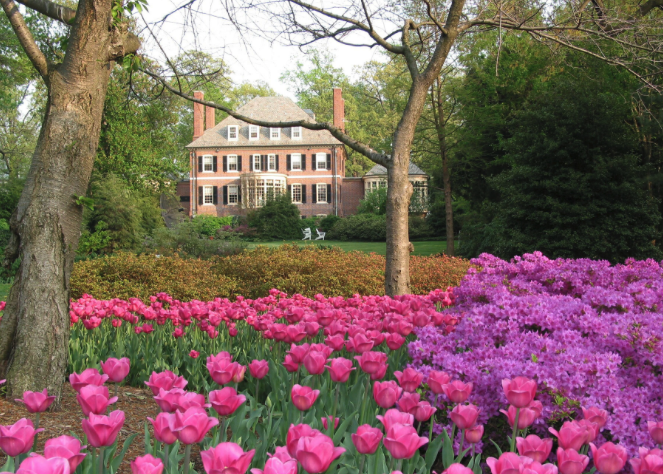
Every spring, something remarkable happens in North Baltimore. Eighty thousand tulip bulbs burst into bloom across six acres of manicured lawn, drawing visitors from across the region to witness one of the most spectacular floral displays in the country. This is Sherwood Gardens, the crown jewel of Guilford—a neighborhood that was planned from its very first survey stake to be, in the words of one historian, a place with plenty of room for Baltimore’s biggest spenders. More than a century later, Guilford remains exactly that: one of Baltimore’s most architecturally distinguished, carefully planned, and quietly prestigious residential communities.
Designed by Frederick Law Olmsted Jr. and developed by the Roland Park Company beginning in 1911, Guilford is a National Register Historic District of roughly 800 single-family homes spread across 210 rolling, tree-canopied acres in North Baltimore. With architecture ranging from charming cottages to John Russell Pope-designed mansions, a location just minutes from Johns Hopkins University’s Homewood campus, and a median home price that has climbed to $1.52 million amid strong recent demand, Guilford occupies a rarefied position among Baltimore’s great historic neighborhoods—beautiful, prestigious, and unmistakably its own.
From a Newspaper Founder’s Country Estate to Baltimore’s Premier Suburb: The History of Guilford
Guilford’s story begins with one of the most consequential figures in Baltimore media history. In 1872, Arunah S. Abell—the founder of The Baltimore Sun—purchased the 210-acre tract that would become Guilford, establishing it as his country estate. The Abell family held the land for 35 years, until 1907, when it was sold to the Guilford Park Company, a group of investors who recognized the property’s potential for development but wanted to ensure it would be built as a single, cohesive community rather than broken into disconnected parcels.
That vision was fully realized in 1911, when the Guilford Park Company consolidated with the Roland Park Company—the same firm that had already built Roland Park into one of the most admired residential communities in America. The Roland Park Company brought in Frederick Law Olmsted Jr., son of the legendary landscape architect behind Central Park, to design Guilford’s master plan. Olmsted approached Guilford’s gently rolling, forested terrain with the same philosophy that had guided his firm’s work nationwide: curvilinear streets that respected the natural topography, a hierarchy of main thoroughfares and quiet secondary roads, “Olmstedian” parks and greens, and a deliberate design that placed house lots facing inward toward shared open spaces—ensuring privacy for residents and a unified, parklike streetscape throughout.
The timing could not have been better. Johns Hopkins University had just announced its move to the nearby Homewood campus, the Maryland Episcopal Diocese had purchased the southern tip of Guilford with plans to build a great cathedral, and extended trolley lines promised direct access to downtown Baltimore. As James Waesche observed in his history of the Roland Park Company, the developers’ intent for Guilford was clear: while the company prided itself on accommodating a range of incomes from cottages to mansions, there was plenty of room reserved for Baltimore’s biggest spenders. Construction proceeded from 1913 through 1950, with homes designed by some of the era’s most celebrated architects, including Edward L. Palmer, the Roland Park Company’s chief architect, working alongside Bouton and Olmsted to bring the vision to life. Guilford was officially listed on the National Register of Historic Places in recognition of its exemplary residential architecture and superior community planning.
What Makes Guilford One of Baltimore’s Most Distinguished Neighborhoods?
Sherwood Gardens: A Springtime Spectacle
No feature defines Guilford in the public imagination more than Sherwood Gardens. What began as a passion project in the 1920s has grown into one of the most famous tulip displays in the entire country. Each April, roughly 80,000 tulip bulbs bloom across six acres in the heart of the neighborhood, joined by dogwoods, flowering cherries, wisteria, and magnolias that turn the gardens into a multi-week celebration of color. Visitors come from across the region to walk the paths, photograph the blooms, and experience a tradition that has become as much a part of Baltimore’s springtime identity as the Preakness or the cherry blossoms at the harbor. For Guilford residents, the gardens are a daily backdrop—a six-acre park that happens to be one of the most photographed landscapes in the city.
World-Class Architecture by Baltimore’s Finest Architects
Guilford’s housing stock is a showcase of early twentieth-century American residential design. Homes were built between 1910 and 1950 and span an impressive range of revival styles: Tudor Revival with steep gables and decorative half-timbering, Colonial Revival with symmetrical brick facades and columned entries, English Arts and Crafts with hand-crafted detailing, and French and Italian Renaissance Revival estates with tiled roofs and formal proportions. Among the most celebrated is the James Swan Frick House, also known as Charlcote House, a monumental Classical Revival masterpiece designed by storied architect John Russell Pope and built between 1914 and 1916. Along St. Paul Street, a winding boulevard lined with early 1900s mansions, the architectural ambition of Guilford’s original developers is on full display. Other notable homes were designed by the firm of Palmer and Lamdin, whose work also defined neighboring Homeland and Cedarcroft. Neighborhood covenants prohibit the subdivision of these historic homes, ensuring that the scale and character established more than a century ago remains intact today.
Parks, Greens, and a Neighborhood Designed for Community
True to Olmsted’s vision, Guilford includes four public parks along with the famous Sherwood Gardens, plus ten smaller private parks reached through residents’ rear gardens—a design feature that gives the neighborhood an unusually layered and intimate sense of shared green space. Guilford Gateway Park, at the end of St. Paul Street, provides another picturesque outdoor destination. A limestone well on Paul Street, dedicated to Edward Bouton of the Roland Park Company, stands as a quiet tribute to the men who planned this community with such care. The Guilford Association, a long-standing homeowners organization, continues that legacy today, organizing community events and social activities that reinforce the close-knit, multigenerational friendships that define life in the neighborhood.
A Location That Can’t Be Beat
Guilford’s position in North Baltimore is one of its greatest practical advantages. The neighborhood is bounded by University Parkway to the south, Charles Street to the west, York Road to the east, and Cold Spring Lane to the north—putting residents just minutes from the Johns Hopkins University Homewood campus, Loyola University Maryland, and Notre Dame of Maryland University. The dining and shopping of Hampden, including neighborhood favorites Johnny’s and Petit Louis Bistro, along with Brightside Boutique and MOM’s Organic Market, are an easy trip away. Downtown Baltimore and the Inner Harbor are roughly three miles south, and neighboring Homeland, Roland Park, and Charles Village extend the same Olmstedian character across North Baltimore’s most celebrated residential corridor.
Famous Past and Present Residents
Guilford’s most celebrated resident may be Grace Turnbull, a twentieth-century sculptor and artist whose distinctive stucco home on Chancery Road—complete with a belltower—was modeled after an inn she once visited in Toledo, Spain. The house remains a highlight of neighborhood tours today. A century ago, Guilford’s grand homes housed members of Baltimore’s elite: physicians, tea importers, inventors, artists, and bankers who wanted to live in a community that matched their ambitions. That tradition of attracting accomplished, engaged residents continues, with Guilford remaining home to professionals across medicine, law, academia, and finance who value the neighborhood’s architectural pedigree and quiet sophistication.
The Maryland House and Garden Pilgrimage
Each spring, many of Guilford’s grand homes open their doors and garden gates to the public as part of the Maryland House & Garden Pilgrimage, a beloved regional tradition that allows visitors a rare glimpse inside some of the city’s most architecturally significant private residences. For a neighborhood that takes preservation seriously, the Pilgrimage is both a celebration of Guilford’s heritage and an opportunity for residents to share their homes’ stories with the wider community.
Guilford Real Estate: Architectural Pedigree at a Premium
The Guilford housing market reflects the neighborhood’s status as one of Baltimore’s most prestigious addresses. Recent data shows a median home sale price around $905,000 to $1.52 million, with homes selling after a median of about 42 days on the market—faster than the national average. Listed homes span a wide range, from updated historic residences in the $700,000s to grand architect-designed estates exceeding $2 million, reflecting the breadth of housing stock from cottages to mansions that the Roland Park Company always intended Guilford to offer. The neighborhood’s roughly 800 homes include midcentury condominiums, Tudor-style brick townhouses, Colonial Revivals, and French-country inspired estates, giving buyers genuine variety within a single, cohesively planned community.
Guilford residents enjoy a median household income that significantly exceeds state and national averages, and the neighborhood’s above-average concentration of professionals in medicine, law, finance, science, and academia speaks to the kind of buyer that Guilford continues to attract. With strict neighborhood covenants protecting against subdivision and a century of careful stewardship by the Guilford Association, the neighborhood’s architectural integrity and property values have remained remarkably stable—even as recent market data shows meaningful price appreciation, reflecting strong and growing demand for one of Baltimore’s truly irreplaceable addresses.
Ready to Discover Guilford?
At The Balcerzak Group, we understand what makes Guilford exceptional—the Olmsted design, the architectural pedigree, Sherwood Gardens, and the close-knit community that has made this neighborhood a Baltimore institution for more than a century. Whether you’re searching for a Tudor Revival on a quiet cul-de-sac, a grand Colonial overlooking the gardens, or simply want to explore what one of Baltimore’s most distinguished neighborhoods has to offer, we have the local expertise to guide you.
Browse current Guilford listings, request a free home valuation, or reach out to start a conversation. Arunah Abell saw the potential in this land in 1872, and the Roland Park Company perfected it in 1911—and we’d love to help you become part of its next chapter.
Click Here for Current Guilford Listings!
— The Balcerzak Group —
Your Local Baltimore County Real Estate Experts
Check out this article next