

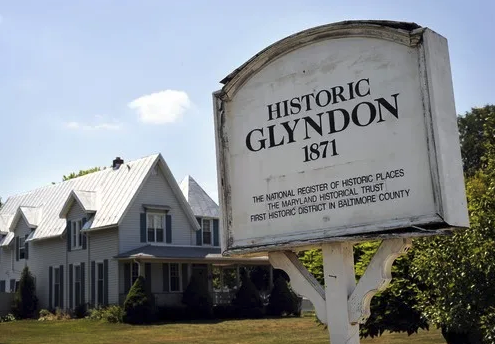
There are planned communities, and then there is Glyndon—a village founded in 1871 by a man who had been knighted by the Russian Czar, served as American Consul to four countries, and decided that what he really wanted to do with his retirement was build a small town where he could live among congenial people of his own tastes and inclinations. Dr. Charles A. Leas, Baltimore City’s first public health officer, hired surveyor Augustus Bouldin to lay out the streets and lots of his 166-acre farm, planted rows of maples along the avenues, and created a Victorian summer village that—more than 150 years later—still looks, feels, and functions remarkably like the place he imagined.
Glyndon is Baltimore County’s first designated historic district, listed on the National Register of Historic Places since 1973 and formally designated as the county’s first Historic District in 1981. With a population of just under 500, a median household income above $118,000, and a collection of two- and three-story Victorian homes on tree-lined avenues that you won’t find replicated anywhere else in the Baltimore region, Glyndon is not just a neighborhood—it’s a living time capsule. And its residents wouldn’t have it any other way.
A Knight, a Railroad, and a Name Picked from a Hat: The History of Glyndon
Dr. Charles A. Leas lived a life that reads like a novel. As Baltimore City’s first health officer, he brought modern public health practices to one of America’s fastest-growing cities. During the Crimean War, he traveled to Russia at the request of the Russian Minister to serve on the army’s medical staff. For that service, Czar Alexander II knighted him with the Imperial Order of St. Stanislaus. President Buchanan then appointed him U.S. Consul to Russia, and in subsequent years he served as American Consul to Sweden, Madeira, and British Honduras. When he finally retired and returned to Baltimore, Leas purchased farmland along the Western Maryland Railway—which had reached this site by 1860—and quickly discovered that farming was not his calling.
What was his calling, it turned out, was town-building. In 1871, Leas hired Augustus Bouldin to survey and plat a small town on his 166-acre farm, situated between Reisterstown and the Worthington Valley. He planted rows of maples along the avenues, sold lots to affluent Baltimoreans seeking summer retreats from the city’s heat, and established a community whose character was defined from the very start by Victorian architecture, railroad connectivity, and an elevated setting—nearly 700 feet above sea level—that provided what residents described as delightful summers and mild winters.
Even the name was serendipitous. According to local tradition, “Glyn” was picked from a hat, giving the community a name that suggested the Welsh word for a small, sheltered valley. The Western Maryland Railway made the town viable, providing daily commuter service to Baltimore some 25 miles away. Affluent city families built two- and three-story Victorian homes with large airy rooms, wide center hallways running front to rear, and spacious wraparound porches designed for summer living. Boarding houses invited even more city residents to experience the country. A small business district grew up around the railroad station, with a post office, general store, town hall, blacksmith shop, livery, wheelwright shop, and ice cream parlor lining Railroad Avenue.
Glyndon’s early story also includes Emory Grove, a Methodist religious campground founded in 1868—even before Glyndon itself—that drew summer visitors via the railroad and a streetcar line. Across Butler Road, Glyndon Park was established in 1887 as a temperance camp meeting ground, the first of its kind south of the Mason-Dixon Line. Sacred Heart Church broke ground in 1873, its Gothic structure built with marble from a nearby quarry. And in 1876, St. George’s Hall opened as a private boarding school for boys, adding yet another layer to a community that, within its first decade, had already become a remarkably complete Victorian village.
What Makes Glyndon One of Baltimore County’s Most Unique and Charming Places to Live?
Victorian Architecture You Won’t Find Anywhere Else
Glyndon’s architectural character is its greatest treasure. The village retains a striking homogeneity of late nineteenth-century residential design—frame cottages and homes, typically two and a half stories, with one- or two-story front porches, gabled rooflines, decorative woodwork, and the generous proportions that defined Victorian domestic architecture at its best. The famous “Loop House” on Waugh Avenue near Emory Grove, built around 1888 with wraparound porches added in 1895, is one of Glyndon’s most photographed homes. Along Chatsworth Avenue, Railroad Avenue, and the surrounding streets, you’ll find homes from the 1880s and 1890s that have been lovingly maintained by generations of owners—many still featuring original architectural details, high ceilings, wide-plank floors, and the expansive porches that were designed for a time when summer living happened outdoors.
Historic Glyndon, Inc., formally organized in 1972, works continuously to preserve and protect the village’s cultural, social, economic, and architectural heritage. Baltimore County’s Historic District designation ensures that exterior modifications are reviewed to maintain the streetscape’s integrity. The result is a community that looks remarkably unchanged from its Victorian heyday—not frozen in time, but carefully stewarded by people who understand what makes Glyndon special.
The Glyndon Swim Club and Community Life
The Glyndon Swim Club, celebrating over 90 years of operation, is the village’s summer social hub—a gathering place where families spend long afternoons, kids compete on swim teams, and neighbors forge the connections that define small-town life. The Glyndon Community Association, formally incorporated in 1945, has been the organizational backbone of the village for nearly 80 years, coordinating events and advocating for the community. And Glyndon’s annual Fourth of July parade is one of the most beloved traditions in all of Baltimore County—a small-town celebration that draws the entire community out to line the streets in a display of patriotism and neighborliness that feels like a Norman Rockwell painting come to life.
The Woman’s Club of Glyndon, which traces its origins to 1898 when a group of ladies “summering” in the village gathered on a neighbor’s porch to read together—calling themselves the Glyndon Porch Class—has been meeting continuously for over 125 years. They now occupy the former 1887 Glyndon School on Butler Road, a charming symbol of the village’s commitment to preserving its buildings and its traditions.
The Birthplace of T. Rowe Price
Among Glyndon’s most distinguished residents was Thomas Rowe Price Jr., born in the village in 1898. Price grew up in Glyndon and went on to found T. Rowe Price Associates, one of the largest and most respected investment management firms in the world, now managing over $1.5 trillion in assets. His pioneering approach to growth stock investing fundamentally changed the American financial landscape. The Leas homestead, the oldest home in Glyndon and located at the corner of Albright and Railroad avenues, is more than 200 years old—a daily reminder that this small village has produced people and ideas that have had an outsized impact on the world.
Sacred Heart Church and Glyndon’s Spiritual Heritage
Glyndon’s religious institutions are woven into the village’s identity. Sacred Heart Church, whose cornerstone was laid in 1873, is a Gothic structure built with marble quarried from the nearby “Dark Hollow Hill.” The parish and its school, Sacred Heart School of Glyndon, continue to serve families across the greater Reisterstown area with a Catholic K–8 education. The Glyndon United Methodist Church, originally built in 1878, was destroyed by fire in 1929 and rebuilt as the handsome stone structure that stands today, dedicated in 1931. These churches aren’t just architectural landmarks—they’re living congregations that have anchored community life in Glyndon for over 150 years.
Worthington Valley, the Maryland Hunt Cup, and Green Spring Valley
Glyndon’s location places it at the gateway to some of Baltimore County’s most treasured landscapes. The Worthington Valley Historic District—also listed on the National Register of Historic Places—lies to the east, offering a landscape of rolling farmland, horse country, and historic estates. The Maryland Hunt Cup, the nation’s most famous timber steeplechase, finishes its course near Glyndon. The Green Spring Valley corridor is a short drive south, with its foxhunting tradition, Robert Trent Jones golf courses, and estate-scale properties. For residents who love the countryside, Glyndon sits at the intersection of some of the most beautiful and historically significant landscapes in the state.
Location: Small-Town Living with Big-Time Access
Glyndon sits at the junction of Butler Road (MD-128) and the former Western Maryland Railway corridor, with Reisterstown immediately to the south and the Worthington Valley to the east. Butler Road connects directly to I-83 (the Baltimore-Harrisburg Expressway) for commuters heading south to Towson and Baltimore or north to Hunt Valley and beyond. I-795 is accessible via Reisterstown, putting the Baltimore Beltway (I-695) and downtown Baltimore about 25 to 30 minutes away. The village’s elevation—nearly 700 feet above sea level—gives it a microclimate that is noticeably cooler in summer and more temperate year-round than lower-lying communities closer to the city. For everyday needs, Reisterstown’s Main Street, the Foundry Row Wegmans in Owings Mills, and the shops along MD-140 are all within a few minutes’ drive. Stevenson University is nearby, and the full range of Baltimore County’s private schools—from Garrison Forest and McDonogh to Calvert Hall and Loyola Blakefield—are within easy reach.
Glyndon Real Estate: Rare, Distinctive, and Worth the Wait
The Glyndon real estate market is unlike anything else in Baltimore County. With a population under 500 and a finite supply of historic Victorian homes in the designated district, inventory is inherently rare. When a home comes to market in Glyndon, it attracts buyers who understand the value of owning a piece of Baltimore County’s architectural heritage—buyers who want wraparound porches, high ceilings, original woodwork, and the kind of village-scale community life that modern development simply cannot replicate. Prices in the historic district typically range from the $400,000s to the $600,000s, with select properties commanding more based on size, condition, and location within the village. The surrounding greater Glyndon area offers additional options on larger lots at a range of price points.
With a median household income above $118,000 and 36% of households including children—ten times the rate of surrounding areas—Glyndon is a village that families choose deliberately. The combination of architectural character, historic designation, community spirit, excellent school access, and proximity to the Worthington Valley and Green Spring Valley corridors makes Glyndon one of the most distinctive residential options in the Baltimore region. Properties here don’t come along often, and when they do, they’re worth acting on.
Ready to Discover Glyndon?
At The Balcerzak Group, we appreciate communities with character—and Glyndon has more character per square foot than almost anywhere in Baltimore County. We understand the historic district, the architectural guidelines, the community dynamics, and the broader market context that makes Glyndon properties so distinctive. Whether you’ve been watching for a Victorian gem to come to market, you’re curious about what life in a 150-year-old village really looks like, or you’re a current Glyndon homeowner wondering what your property is worth today, we’d love to help.
Browse current Glyndon listings, request a free home valuation, or reach out to start a conversation. Dr. Leas wanted to build a town where he could live among congenial people. More than 150 years later, that’s exactly what Glyndon still is—and we’d love to help you become part of it.
Click here for current Glyndon Homes for Sale!
— The Balcerzak Group —
Your Local Baltimore County Real Estate Experts
Check out this article next