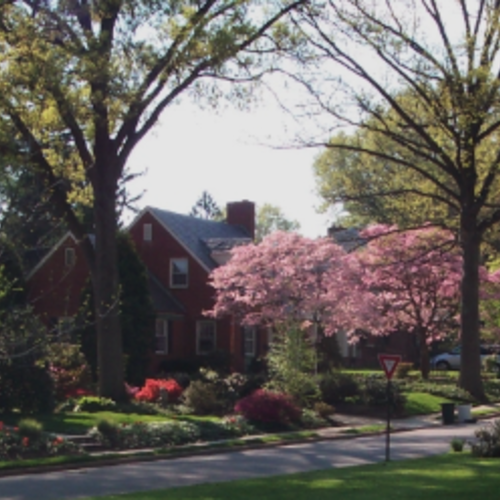


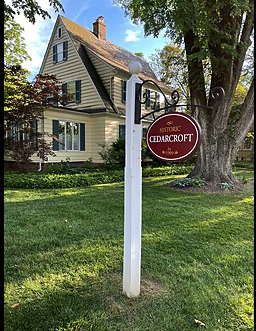
There are neighborhoods, and then there are neighborhoods that stop you in your tracks. Cedarcroft is the latter. Tucked into North Baltimore on gently sloping land bordered by York Road, Bellona Avenue, Gittings Avenue, and East Lake Avenue, Cedarcroft is a pocket-sized historic district where towering old-growth sycamore trees arch over narrow streets like the vaulted ceiling of a cathedral. The homes beneath that canopy—Dutch Colonial Revivals, Tudor Revivals, Federal Revivals, Craftsman bungalows—were designed by some of Baltimore’s most celebrated early twentieth-century architects and built with a level of care that has aged beautifully over more than a century.
Listed on the National Register of Historic Places, Cedarcroft is a neighborhood that looks much as it did in the mid-1900s, yet feels vibrantly alive today. With roughly 98% of its homes occupied—over 91% by owners—and a community that comes together naturally for block parties, Halloween parades, and an annual progressive dinner, Cedarcroft is that rare find: a historic neighborhood with real heart. If you’re searching for a home in the Baltimore area with genuine architectural character, old-growth beauty, and a welcoming community, Cedarcroft deserves a place at the very top of your list.
From Country Estate to Architectural Gem: The History of Cedarcroft
Cedarcroft’s roots stretch back to the mid-nineteenth century, when the very first house on the property was built in 1846—likely by a member of the Hopkins family. In 1885, Philip E. Lamb, a commission merchant in downtown Baltimore, purchased 25 acres fronting York Road north of the rural village of Govanstown. He later added another 20 acres, named the estate Cedarcroft, and in 1886 built a substantial Victorian mansion at what is now 6204 Sycamore Road. That Eastlake-style home, with its cross-gable roof, sash windows, and Doric-columned porch, still stands today as the neighborhood’s founding landmark.
After Lamb’s death, his heirs recognized the potential of the 45-acre estate. Around 1910, they formed the Cedarcroft Land Company along with investors George Van Hollen, William McGeen, C.L. Applegarth, and—crucially—architect Edward L. Palmer Jr. Palmer was no ordinary designer. He was the chief architect for the renowned Roland Park Company and would later become famous for his work in Guilford, Homeland, and Roland Park—some of Baltimore’s most prestigious neighborhoods. Palmer didn’t just design individual homes in Cedarcroft; he planned the entire community, laying out curvilinear streets on the gently sloping terrain and establishing the architectural standards that would give the neighborhood its enduring character.
By 1921, thirty homes stood within the neighborhood’s boundaries, and every lot had been sold. The Cedarcroft Land Company was dissolved, and in its place the Cedarcroft Maintenance Corporation and Improvement Association were formed—carrying forward all the covenants and design standards that had guided the original development. Construction continued through the 1920s, 1930s, and into the postwar years, with the neighborhood essentially built out by the mid-1950s. Remarkably, in 2016, a new home was constructed on the final unbuilt lot—the first new house since 1953.
What Makes Cedarcroft One of Baltimore’s Most Magical Neighborhoods?
The Sycamores: A Canopy Like No Other
Ask anyone who’s been to Cedarcroft what they remember most, and the answer is almost always the trees. The neighborhood’s old-growth sycamores line the narrow, sloping streets and reach across to form soaring natural arches that residents describe as reminiscent of medieval cathedral vaults. In summer, the canopy provides deep, cool shade. In fall, the mottled bark and golden leaves create a visual spectacle. In winter, the elegant, bone-white branches stand against the sky like living sculpture. These aren’t decorative plantings—they’re trees that have been growing for well over a century, and they give Cedarcroft a sense of permanence and natural beauty that simply cannot be replicated.
Architect-Designed Homes with Serious Pedigree
Cedarcroft’s housing stock is extraordinary for a neighborhood of its size. Because Edward L. Palmer Jr.—who went on to design some of the finest homes in Roland Park, Guilford, and Homeland—served as the community’s master planner and principal architect, the homes here carry a design pedigree typically associated with Baltimore’s most exclusive addresses. The dominant styles are Dutch Colonial Revival (distinguished by signature gambrel rooflines), Federal Revival (making up roughly 30% of the district), and Tudor Revival, but you’ll also find Georgian Revivals, Cape Cods, Arts and Crafts bungalows with fumed oak woodwork and built-in cabinetry, and even touches of Italianate architecture. Each home was built to the neighborhood’s plan and color scheme regulations, yet Palmer’s genius was in making each one feel individual. As one local architect noted, some homes are arranged ingeniously—four cottages in a row that all appear to be completely different houses.
Inside, these homes reward buyers with the kind of details that modern construction rarely delivers: original hardwood floors, detailed woodwork, fireplaces, built-in cabinets, and solid construction that has held up beautifully for nearly a century. Many homeowners have thoughtfully updated kitchens and bathrooms while preserving the character that makes a Cedarcroft home unmistakable.
Traditional Neighborhood Design That Actually Works
Long before “walkability” became a buzzword in real estate, Cedarcroft was built on the principles of traditional neighborhood design. The proportions are deliberate and human-scaled: the size of the homes relative to their lots, the width of the streets, the spacing of the trees—everything works together to create a place that feels charming and livable in a way that postwar subdivisions rarely achieve. The curvilinear street layout discourages cut-through traffic while inviting residents to walk and linger. It’s a neighborhood designed for people, not cars, and that philosophy has aged remarkably well.
A Community That Celebrates Together
Cedarcroft may be small—just a few hundred homes—but its social life punches well above its weight. The neighborhood is known for its October block parties, Halloween parades that draw the whole community out, Christmas decoration contests, and perhaps most memorably, an annual progressive dinner where neighbors move from house to house, sharing food and conversation. The Cedarcroft Maintenance Corporation and Improvement Association remain active, maintaining the architectural standards that protect property values while fostering the kind of genuine neighborliness that defines life here. As longtime residents are quick to point out, Cedarcroft is friendly and relaxed—not the stuffy, rule-bound environment that some historic neighborhoods can become.
Parks, Culture, and the Senator Theatre
Cedarcroft’s location gives residents easy access to some of Baltimore’s best outdoor and cultural destinations. Chinquapin Run Park is nearby, offering 76 acres of streams, athletic fields, and a playground. For a bigger outdoor adventure, Lake Roland Park is just three miles away, with over 500 acres of woodlands, wetlands, hiking trails, a nature center, and a lake with cascading waterfalls. And for a night out, the historic Senator Theatre—an Art Deco landmark built in 1939—is a beloved neighborhood institution that screens everything from new releases to cult classics. Downtown Baltimore, with its museums, restaurants, and professional sports venues, is a quick fifteen-minute commute.
Location: Where Baltimore City Meets the Towson Corridor
One of Cedarcroft’s most underappreciated advantages is its position right at the border of Baltimore City and Baltimore County. Technically within city limits, Cedarcroft sits along York Road just south of the county line, giving residents easy access to both worlds. Downtown Towson—with Towson Town Center, The Shops at Kenilworth, and a growing restaurant scene—is a short drive north. Downtown Baltimore and the Inner Harbor are fifteen minutes south. Johns Hopkins University, Towson University, Goucher College, and major medical centers are all nearby, making Cedarcroft a natural choice for academics, medical professionals, and anyone who values a central location. The York Road corridor provides direct access to I-695 and I-83 for broader commuting.
Cedarcroft is served by the Baltimore City Public Schools district, with students attending the well-regarded Roland Park Elementary/Middle School. Private school options in the area are plentiful, including nearby Calvert Hall, Loyola Blakefield, Bryn Mawr, and Friends School.
Cedarcroft Real Estate: Historic Character, Strong Value
The Cedarcroft housing market offers something increasingly rare: architect-designed, historically significant homes with genuine character at price points well below what comparable pedigree commands in neighborhoods like Roland Park or Guilford. The median home price in Cedarcroft currently sits around $590,000 to $615,000, with an average household income of approximately $167,000 and a homeownership rate above 84%. Homes average around 2,400 square feet and typically sell within two to three weeks of listing—a reflection of steady demand and extremely limited inventory in a neighborhood where the last vacant lot was built on nearly a decade ago.
For buyers who appreciate traditional architecture, fumed oak woodwork, slate roofs, and the kind of thoughtful proportions that only early twentieth-century planning delivers, Cedarcroft represents an outstanding investment. The combination of National Register status, an active maintenance corporation that protects architectural standards, and a community that takes pride in its homes creates a neighborhood where values have held strong and quality of life remains exceptionally high.
Ready to Discover Cedarcroft?
At The Balcerzak Group, we love connecting buyers with neighborhoods that have real soul—and Cedarcroft is one of Baltimore’s most soulful places to live. We know the streets, the homes, the history, and the market, and we’re here to help you find the right fit. Whether you’re drawn to a gambrel-roofed Dutch Colonial on a tree-canopied lane, a Tudor Revival with Arts and Crafts woodwork, or simply want to explore what Cedarcroft has to offer, we’d love to guide you.
Browse current Cedarcroft listings, request a free home valuation, or reach out to start a conversation. Once you walk under those sycamores, you’ll understand why the people who live here never want to leave.
Click here for current Cedarcroft homes for sale!
— The Balcerzak Group —
www.thebalcerzakgroup.com
Your Local Baltimore County Real Estate Experts
Check out this article next