

Some neighborhoods are well-planned. A handful are beautifully designed. And then there’s Homeland—a neighborhood that was conceived as a work of art. Planned by the Olmsted Brothers, the same landscape architecture firm behind New York’s Central Park, and developed by the legendary Roland Park Company, Homeland is nearly 1,000 homes set among winding tree-lined streets, six ornamental lakes, and an astonishing range of architect-designed residences that span Georgian Revivals, Tudor Revivals, Norman Cottages, Colonial masterpieces, and more. It is, without exaggeration, one of the most beautiful planned residential communities in the United States.
Named one of the top 50 urban neighborhoods in America by Worth Magazine, listed on the National Register of Historic Places with over 1,600 contributing buildings, and home to an average household income exceeding $223,000, Homeland occupies a rarefied position in Baltimore’s residential landscape. And yet, for all its prestige, Homeland is not stuffy or exclusive in spirit. It’s a community where neighbors gather around the lakes in spring to admire the cherry blossoms and daffodils, where children ride bikes along curvilinear streets that were designed to slow traffic and foster connection, and where a Fourth of July parade still brings the whole neighborhood out to celebrate.
From Country Estate to National Treasure: The History of Homeland
The land that became Homeland has deep roots in Maryland history. The original tract, called “Job’s Addition,” was surveyed by Job Evans in 1695. Over the following century, the property changed hands and grew until David Maulden Perine—Baltimore’s register of wills—purchased the estate in the mid-1800s and expanded it to 391 acres. Perine renamed the property “Homeland” and transformed it into a working farm with a grand manor house. In 1843, he had a chain of six ornamental lakes dug along a natural hollow, fed by a 2,100-foot conduit from the estate’s head springs. One of the ponds he affectionately named “Banjo Pond” for its distinctive shape. Those lakes survive today as Homeland’s most iconic feature.
The Perine family kept the estate intact for decades and played a central role in founding the nearby Church of the Redeemer in 1855. But by the early 1920s, the era of the great country estates along the York Road corridor was ending. In 1924, the Perines sold the property to the Roland Park Company—the same visionary development firm that had already created Roland Park and Guilford, two of Baltimore’s most admired neighborhoods.
The Roland Park Company brought in the Olmsted Brothers to design the community’s layout. The Olmsteds—sons of Frederick Law Olmsted Sr., the father of American landscape architecture—applied the same principles that had guided their work across the country: curvilinear streets that followed the natural contours of the land, roadways rerouted to save venerable oaks, and an abundance of public green spaces to foster community life. The result was a neighborhood that felt organic rather than imposed, as if the houses had grown naturally among the trees and lakes.
Construction began in the mid-1920s and continued through the 1940s, with the Roland Park Company encouraging a deliberate shift away from the Victorian sensibility of older Roland Park toward more traditional eighteenth-century architecture. A roster of Baltimore’s finest architects—including Edward L. Palmer Jr., William D. Lamdin, William Gordon Beecher, Benjamin and Parke Flournoy, and others—designed homes in a breathtaking range of styles, from Georgian and Federal Revival to Tudor, Norman Cottage, French Eclectic, and Spanish Colonial. The streets were given English-sounding names—St. Dunstan’s, Tunbridge, Paddington, Upnor—lending the neighborhood an unmistakably Anglo atmosphere. In 2001, the Greater Homeland Historic District was listed on the National Register of Historic Places with 1,616 contributing buildings.
What Makes Homeland One of Baltimore’s Finest Neighborhoods?
The Six Lakes: Homeland’s Living Centerpiece
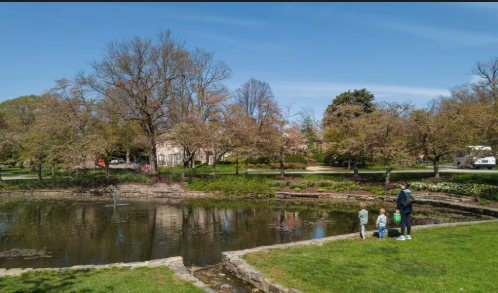
No feature defines Homeland more powerfully than its chain of six ornamental lakes running down Springlake Way. Originally dug in 1843 by David Perine to water his estate, the lakes have become the social and scenic heart of the neighborhood. Residents walk, jog, and push strollers along the paths that wind between them year-round. In spring, the scene is spectacular: cherry blossoms and thousands of daffodils burst into bloom around the water’s edge, creating a sea of pink and yellow that draws visitors from across Baltimore. In fall, the surrounding canopy of mature trees reflects off the water in brilliant oranges and reds. The lakes are not just decorative—they’re where the community comes together, the place where neighbors pause, connect, and share the beauty of where they live.
Olmsted-Designed Streets and Public Spaces
Homeland’s street plan is itself a masterpiece. The Olmsted Brothers designed arterial boulevards for through traffic, winding secondary streets for residential quiet, and “back-turning” courts that create intimate clusters of homes. The curvilinear layout follows the natural topography, slows traffic naturally, and creates a series of small public green spaces—pockets of shared landscape where families gather and children play. These aren’t afterthoughts; they were integral to the Olmsted philosophy that beautiful shared spaces are the foundation of community life. Walking through Homeland today, you experience the same sense of discovery and calm that the designers intended nearly a century ago.
Architecture That Rivals Any Neighborhood in America
Homeland’s architectural diversity is staggering. The neighborhood contains examples of Federal Revival, Tudor Revival, Georgian Revival, Dutch Colonial Revival, Cape Cod Revival, Norman Cottage, French Eclectic, French Renaissance, Spanish Eclectic, Williamsburg Revival, Jacobethan Revival, Italianate, Victorian Gothic, Queen Anne, Bungalow, Mansard, Contemporary, and Ranch styles—all within a single cohesive community. The architects who designed these homes viewed their work as a social art, believing that beautiful residential design could improve the lives of the people who lived in it. The result is a neighborhood where every block offers something visually extraordinary, from grand brick Georgians with slate roofs and columned porticos to intimate stone Norman cottages with arched doorways and steeply pitched rooflines. Inside, buyers find hardwood floors, original fireplaces, built-in bookshelves, second-floor porches, and the kind of craftsmanship that defines a bygone era of homebuilding.
The Homeland Association’s architectural committee reviews all exterior modifications, ensuring that the neighborhood’s character is preserved without stifling individual expression. Homeowners can also take advantage of historic tax credits—currently a 20% credit for qualified restoration work—making investment in these already-exceptional homes even more rewarding.
Sherwood Gardens, Belvedere Square, and the Church of the Redeemer
Homeland’s surroundings are as compelling as the neighborhood itself. Nearby Sherwood Gardens is one of Baltimore’s most beloved public parks, famous for its breathtaking display of thousands of tulips each spring—an annual tradition that draws visitors from across the region. Belvedere Square, just minutes away, offers boutique shopping, gourmet ingredients at the Belvedere Square Market, fine dining, and live entertainment. The historic Church of the Redeemer, founded in 1855 with the support of the Perine family, anchors the neighborhood’s spiritual and architectural heritage. And for larger outdoor adventures, Lake Roland Park is nearby with over 500 acres of woodlands, wetlands, hiking trails, a nature center, and kayaking.
Schools and Institutions
Homeland is zoned for Roland Park Elementary/Middle School, one of Baltimore City’s most sought-after public schools and home to the Ingenuity Project, an advanced math and science program for gifted students. For high school, Baltimore Polytechnic Institute earns strong marks. The private school landscape is equally impressive: Gilman School, Bryn Mawr School, Roland Park Country School, Loyola Blakefield, Calvert Hall, and Friends School are all nearby. Loyola University Maryland, Johns Hopkins University’s Homewood campus, and Notre Dame of Maryland University are within easy reach, making Homeland a natural home for families and academics alike.
Location: The Best of Baltimore at Your Doorstep
Homeland sits in North Baltimore with Charles Street and Roland Park to the west, Guilford to the south, and Cedarcroft and the Baltimore County line to the north. This position gives residents seamless access to both Baltimore City and the Towson corridor. Downtown Baltimore and the Inner Harbor are a quick drive via Charles Street or I-83. Downtown Towson—with Towson Town Center, restaurants, and the county courthouse—is minutes north. Commuters benefit from easy access to I-695, I-83, and multiple bus lines. The neighborhood’s central location also means short commutes to major employers including Johns Hopkins Hospital, the University of Maryland Medical System, Towson University, and the many corporate offices along the I-83 corridor.
Homeland Real Estate: Prestige with Range
The Homeland housing market offers a rare combination of historic prestige and price range. Homes span from brick duplexes and more modest Colonials starting around $300,000 to grand architect-designed estates exceeding $1.5 million, with the neighborhood’s average sale price currently around $630,000 to $686,000. With an average household income above $223,000, over 88% owner-occupancy, and 41% of residents holding graduate or professional degrees, Homeland attracts discerning buyers who value architecture, landscape, and community in equal measure.
Nearly 98% of Homeland’s homes are occupied—a remarkable figure that speaks to the neighborhood’s enduring desirability. Homes typically sell within three to four weeks, and the Homeland Association’s strict architectural covenants ensure that values are protected over time. For buyers seeking a historically significant, Olmsted-designed home in one of America’s most celebrated urban neighborhoods, Homeland represents an investment in both quality of life and long-term value.
Ready to Experience Homeland?
At The Balcerzak Group, we understand what makes Homeland extraordinary—the Olmsted design, the lakes, the architecture, the community—and we’re here to help you find your place in it. Whether you’re searching for a stately Georgian on Springlake Way, a charming Tudor tucked along a winding lane, or simply want to explore what’s available in one of Baltimore’s most prestigious addresses, we have the local expertise to guide you every step of the way.
Browse current Homeland listings, request a free home valuation, or reach out to start a conversation. There’s a reason people who move to Homeland tend to stay for generations—and we’d love to help you discover it for yourself.
Click Here for Current Homeland Real Estate Listings!
— The Balcerzak Group —
www.thebalcerzakgroup.com
Your Local Baltimore County Real Estate Experts
Check out this article next